


|
 |
| issue | issue > commercial breeders
Large-scale commercial dog and cat breeding is a business. These businesses mass produce and sell puppies or kittens for profit. The fact that the "products" produced are living, sentient beings (as are the adult dogs and cats used for the breeding) makes this issue complicated and controversial. An overview of some highlights of Minnesota commercial dog breeders is below; other data is found throughout this website. Our research focuses on the mass production of puppies, which is more prevalent than the mass production of kittens.
PROFILES: COMMERCIAL DOG BREEDERS
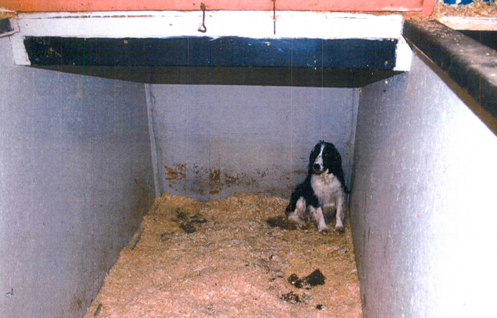
Photo from breeding kennel owned by Deborah Rowell; she was convicted of animal cruelty. The Board of Animal Health granted this breeder a state license after the conviction and this breeder continues to operate. Scroll to bottom of page for link to full story. LICENSING Dog breeders and brokers vary as to the type of license required based on size, number of animals produced, and who they sell the animals to, such as to consumers directly or wholesale (i.e., pet stores). Some facilities require a federal license, administered by the United States Department of Agriculture (USDA); some require a state license, administered by the Board of Animal Health (BAH); some require a local license or permit based on location; and some require no federal, state, or local license. Some Minnesota dog breeders have been operating for decades. As of October 2024:
These federal and state licensed facilities only represent breeders who meet the definition of "commercial dog breeder." There are hundreds of other smaller breeders located and operating throughout Minnesota. In the 2016 Board of Animal Health annual report, the agency reported that they had also "identified 458 other dog or cat breeders in the state who do not need a commercial breeder license because they have fewer than 10 animals or produce less than six litters of puppies or kittens per year." This data was not reported in prior or subsequent BAH annual reports. Licensing does not suggest that the breeder or broker is qualified or professional in the care and welfare of animals; in fact, a federal or state license may falsely give a "stamp of approval" for facilities that mass produce puppies, often favoring the livelihood of the business rather than the welfare of the animals. NOTE: No breeder can obtain a state or federal license without first being granted a local permit from their city or county (if that community requires a kennel permit). This is why it's critical to work within your own community — stop conditional or interim use permits from being granted before the business can begin. For actions by Animal Folks in Winona County regarding local permits, go to: speakupwinonacounty.org
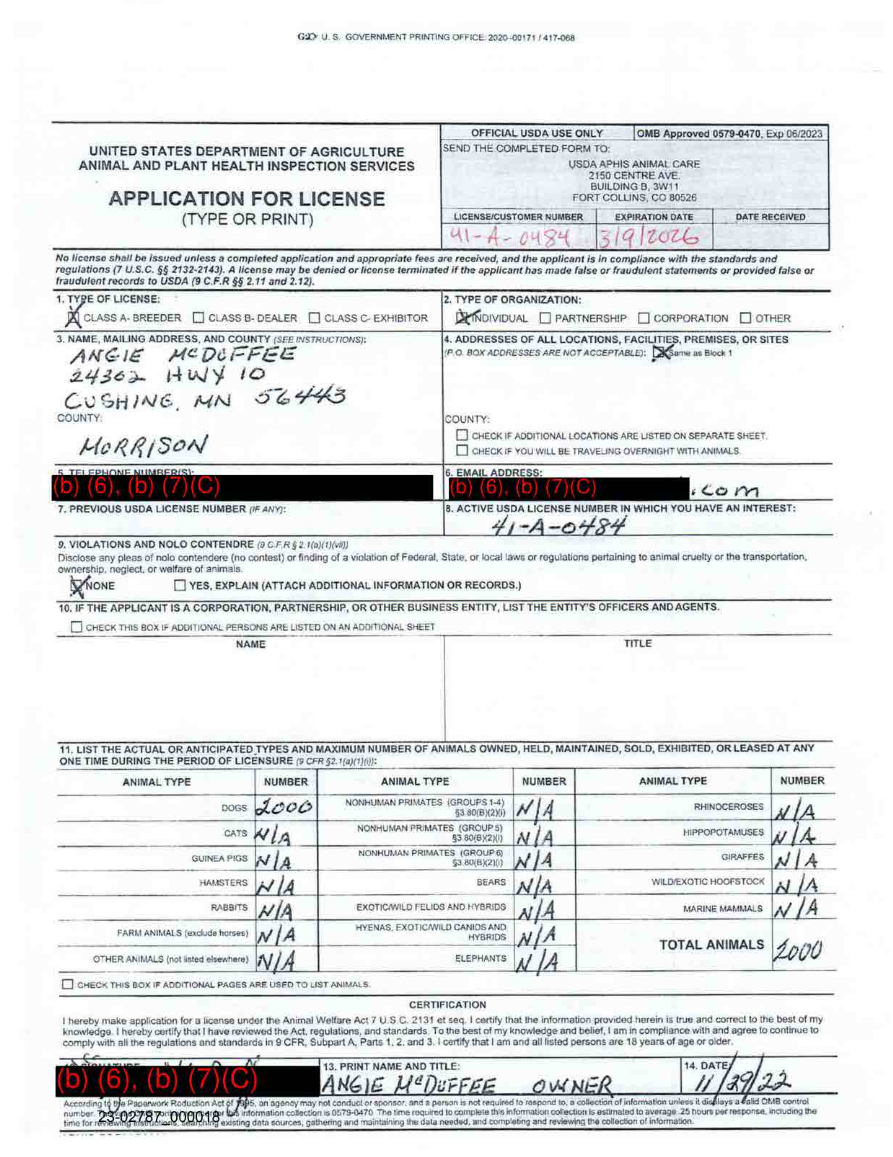
HIGHLIGHTS - OF INTEREST • A.J.'s Angels, Morrison County A.J.'s Angels is the largest commercial dog breeding facility in Minnesota. This facility is USDA-licensed (#41-A-0484) and state-licensed, and has a local permit (granted years ago for "the property") which allows this kennel to have up to 800 adult dogs. This facility was granted a federal license in March 2016 under the owner Angie McDuffee and with a new name: A.J.'s Angels. This kennel was operating at this same location for decades under the name Clearwater Kennel. At one time, Clearwater Kennel had inventory counts as high as 1,700+ dogs and puppies. The owner of Clearwater Kennel was Wanda Kretzman, who is the mother-in-law of Angie McDuffee. The kennel cancelled its federal license in March 2016 and transferred the facility to Angie McDuffee after Kretzman had faced multiple violations of the Animal Welfare Act; except for a small civil penalty, the USDA took no action in regard to the violations once the kennel was transferred. Read more: Clearwater Kennel. In 2022, the breeder (Angie McDuffee) reported on her USDA license application that the kennel may have 2,000 dogs at any one time. In 2022, USDA inspection reports stated that this breeder had 885 dogs and puppies in their kennel. Per the October 2021 USDA inspection report, A.J.'s Angels had a total of 1,172 dogs and puppies.
• Valley View Kennel, Meeker County Valley View Kennel, owned and operated by Paul and Sheila Haag, was (and may still be) the second largest commercial dog breeding facility in Minnesota with over 1,038 dogs and puppies as recorded on the October 2018 USDA inspection report. In August 2019, Paul Haag cancelled his federal license (#41-A-0281). This dog breeder still has a state license - however, the MN Board of Animal Health (state agency) will not disclose any breeder information so it is impossible to verify how many dogs are at this kennel. The Haags also own and operate Amazen' Farmyard in Meeker County, which is a petting zoo and acts as a pet store where puppies are sold. He has a USDA Class C license as an exhibitor. The Amazen' Farmyard website advertises puppies for sale and links to a Valley View Puppies website. How can a dog breeder still operate without a federal license? USDA licensing requirements under the Animal Welfare Act (federal law) state that "anyone selling pets sight unseen at retail must be licensed." This includes facilities that sell their puppies wholesale (i.e., to pet stores or other breeders) or who sell to consumers online, sight unseen (i.e., click and ship). If a breeder only sells to consumers in person so the person can see and touch the animal, they do not require a federal license. In past years, Valley View Kennels sold to pet stores in Minnesota, such as to Four Paws and A Tail in Blaine, and other pet stores nationwide, including Washington, North Dakota, North Carolina, Iowa, and other states. The breeder cancelled his federal license in 2018 but maintained his state license, indicating that this breeding facility is selling all puppies directly to consumers where consumers have access to the animal prior to purchase. NOTE: Other dog breeders who were formerly licensed by the USDA (federal government), have also cancelled their federal license and yet still operate in Minnesota. Example: Possehl Enterprises in Hartland, Minnesota (Freeborn County) had first obtained a federal USDA breeder license in 1996; final cancellation of its federal license was in 2012. Possehl Enterprises has a Minnesota state license; except for number of licensees, no data is provided to the public by the Board of Animal Health about licensed commercial dog or cat breeders.
• Country Pride Kennel, Cass County Country Pride Kennel is a dog breeding facility owned by Deborah Rowell and operating in Cass County. This breeder was licensed by the USDA but cancelled her federal license in 2012. Due to multiple complaints submitted by Animal Folks, an investigation of this breeder was conducted by local law enforcement resulting in the seizure of all her dogs (over 100) at the facility. Rowell was convicted of animal cruelty in 2013. However, in 2015, the MN Board of Animal Health (BAH) granted this breeder a state license, in violation of the breeder law — showing inept administrative and procedural policies by the BAH. This breeder continues to breed and sell dogs to the public. This is another example illustrating why the Companion Animal Board (CAB) bill must be passed, and the enforcement of the breeder law must be transferred from the BAH to the CAB. Read more about the Rowell case.
• Dayna Bell, Dakota County One of the most "successful" animal cruelty cases against a dog breeder is State of Minnesota v. Dayna Bell. For years, Bell was licensed by the USDA; however, she was convicted of 13 counts of felony animal cruelty per Minnesota law. Of interest: Bell appealed this verdict, arguing that her "breeding adult dogs" were livestock and not pet/companion animals. (In Minnesota, a felony penalty only applies to animals that meet the definition of pet and companion animal, service animals, and animals used in fighting.) Bell appealed the case to the Court of Appeals, who affirmed the jury's decision — agreeing that all dogs and puppies at the kennel met the definition of pets/companion animals. Bell also filed a petition with the MN Supreme Court who denied hearing the case. This case is critical to any discussion of care and welfare of adult breeding dogs in a breeding facility. Read more at Dayna Bell case.
• Fulton Enterprises, Freeborn County Fulton Enterprises, owned by Patrick and Tammy Fulton, is one of the largest dog brokers in Minnesota, located in the city of Alden. It appears Fulton does not breed dogs (as some other brokers do) but instead focuses on buying puppies from other breeders and re-selling and shipping these puppies to pet stores nationwide. With no access to sales data, it is difficult to determine the volume of puppies flipped by this broker per USDA inspection reports (which ofen list zero animals). Fulton's federal license application filed in 2022, however, reports the kennel having 2,614 dogs at any one time. Past export certificates show sales to multiple states, including Michigan, Connecticut, New York, Maryland, Virginia, Washington, and other states. CVIs also show Fulton received 245 puppies in December 2023 from 10 breeders in Iowa, including 172 puppies from Joanna and Marvin Newswanger (Maple Tree Kennels). This breeder is most likely buying from MN breeders and other states. Fulton Enterprises first obtained a federal dog broker license in 1995 and cancelled this license in 1999. Another facility had been operating in the same location for years under the name Toenges Enterprises, who had obtained their license in 1960 (per USDA) and cancelled it in January 2010. Fulton Enterprises obtained a new federal license in March 2010 (#41-B-0262).
• Menning Enterprises (now Rockview Kennels), Pipestone County Menning Enterprises LLC is now doing business as Rockview Kennels, LLC. Name change was filed in April 2023. Same kennel address: 269 165th Avenue, Edgerton, Minnesota. The president and agent listed for Rockview Kennels is Wesley Johnson. It is unclear if the kennel was sold to Johnson. Menning Enterprises (now Rockview Kennels) has operated as one of the largest USDA-licensed brokers in Minnesota. Former federal license was 41-B-0081 (cancelled 02/26/21). Federal license application in 2021 reported 623 dogs at any given time. Current federal license is: 41-B-0282. In March 2024, this kennel reported 555 dogs (380 adult dogs ad 175 puppies) on its USDA inspection report. In 2023, this facility was reported to have 665 dogs and puppies (393 adult dogs and 272 puppies). In February 2021, the facility had an inventory count of 616 dogs (405 adult dogs and 210 puppies). In 2016, this facility was reported to have 897 dogs and puppies. For "inventory counts" from prior years, go to Broker Profiles. Menning Enterprises was known for contracting with other local breeders in the area to buy and re-sell their puppies to pet stores in Minnesota and nationwide. It is assumed that Rockview Kennels is using the same breeders and selling to simialr pet stores. Years ago, one Wisconsin pet store (Angel's Pet World) had purchased puppies from this breeder/broker; too often, the puppies were sick, costing the pet store owner thousands of dollars to medically treat the animals. Angel's Pet World severed all ties with this dog breeder and switched to become a humane pet store - no longer buying from puppy mills but instead working with animal rescue groups.
• Winona County commercial dog breeders Winona County has the highest concentration of commercial dog breeders in Minnesota, with multiple USDA-licensed facilities. Other non-USDA-licensed facilities exist in this area. Animal Folks is working with Winona County residents and the county board to pass a ban on future conditional use permits for dog breeding facilities. Learn more at: speakupwinonacounty.org
• Lapse in USDA inspection reports One area of concern in recent years is that several USDA-licensed facilities were not inspected annually, even though they have active licenses. Animal Folks was told by a USDA supervisor that the agency was behind due to COVID, and that a new licensing rule has slowed some processes down temporarily.
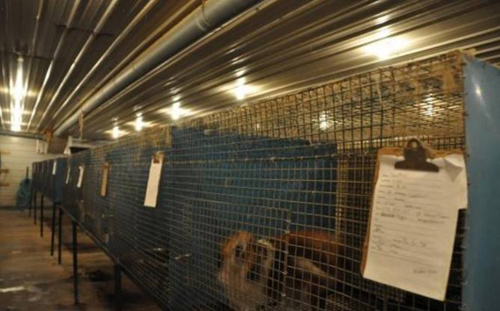
• Dogs breeders, Becker County Dog breeding facilities are located throughout the state of Minnesota. Some of these breeding facilities have been operating for decades. Two large commercial breeders, in particular, that mass produced puppies for many years were located in Becker County: Michelle Sonnenberg (photo below) and Lyle Renner (Bluewater Creek Kennel). Per 2019 USDA inspection reports, Sonnenberg was reported to have 152 adult dogs and 23 puppies. Renner was reported to have 115 adult dogs and 23 puppies. It appears both have cancelled their USDA license; it is unclear if they are still in operation. Photo below shows inside of Sonnenberg kennel; source: USDA inspection report.
• Revocation of license In the past years, the USDA has revoked 5 breeder licenses. Some of these revocations happened after animal cruelty charges (under Minnesota law) were filed by the community. Breeder names are below. Descriptions and documentation for some of these breeders are provided on this page (scroll below).
NOTE: Years ago, Animal Folks filed a complaint against Kenneth Schroeder with the Board of Animal Health, who had licensed this facility under the kennel law (Schroeder bred and sold dogs to institutions primarily for medical experimentation); the MN Board of Animal Health took no action with his state license. The USDA proceeded with revocation. There is no information about any enforcement actions taken by the Minnesota Board Animal Health in regard to revocation of state licenses. In its annual reports, the BAH lists a high-level summary of total correction orders, but provides no data as to type of violations or type of enforcement actions. The BAH's data retention policy for all data pertaining to commercial dog breeders under the breeder law is two years.
• LICENSING: Minnesota Board of Animal Health Some commerical dog and cat breeders are required to be licensed and inspected by the State of Minnesota, as defined by the breeder law: Minn. Stat. sec. 347.57-.65. This law is administered by the MN Board of Animal Health (BAH), which is governed by livestock producers. The state licensing requirements differ from federal licensing requirements. Under MN state law, a commercial breeder is defined as:
The fee for licensure is $10 per adult intact animal (minimum of $100) up to a maximum of $250; with a one-time registration fee of $50. This means a kennel with over 700 intact dogs pays the same fee as one with 10 adult dogs. When the breeder bill was originally lobbied, a sliding scale was proposed to more accurately reflect kennel size and inspection costs but the BAH lobbied against a higher fee. The following state licenses have been granted in the past years, as published in the BAH annual reports:
The list of licensees can be found at: Licensed Minnesota Dog or Cat Breeders The link above lists a count of 148 licenses as of 02-02-24. In April 22, the link had listed 160 licensees. Both differ from the counts in the BAH's annual report as noted above; the BAH has not explained why there is a difference per the online list and annual report. The BAH does not disclose locations, breeder names, or any details about the licensees, including inspection reports, enforcement actions (specific violations), annual reports, inventory counts, or other matters pertaining to the breeder law. When the breeder bill was being lobbied years ago, the BAH and the Pet Breeders Association lobbied to have all data classified as private or nonpublic — not available for review by the public. This data privacy was included in the law (see subdivision 6b of Minn. Stat. sec. 13.643). As noted in the law (subd. 6c), however, the BAH can still provide data to any person or the public per language below. The BAH has chosen not to provide this data, as illustrated by denials of data requests filed by multiple individuals and organizations.
Key concerns about the Board of Animal Health and its enforcement of the breeder law are a lack of transparency (disclosure of data), lack of oversight (BAH reports to no state department), lack of necessary expertise and skills for canine and feline mental and physical well-being (agricultural advisors as inspectors; livestock veterinarians establish process), and a philosophy of regulatory law that favors business (minimal enforcement action), rather than animal welfare, which influences how the breeder law is interpreted and enforced. This philosophy is similar to the USDA guiding principles, as reflected in audits: animal production and "the livelihood of the business" versus prioritizing the welfare of each animal. As stated in the BAH's annual reports:
The above explains, in part, why the Companion Animal Board is needed, which, when passed, will enforce the dog and cat breeder law, among other duties. The primary mission of the Board of Animal Health is the prevention and control of dangerous animal disease. Companion animal issues will never be the BAH's priority — nor should it be. Establishment of the Companion Animal Board will free up the BAH to more effectively fulfill its duty of animal disease control.
BREEDER PROFILES: Examples Minnesota is home to some of the largest puppy mills in the United States. Some of these facilities violated the Animal Welfare Act, as well as Minnesota animal cruelty laws. Animal Folks has profiled multiple kennels below; additional information will be provided for Johnson, Richards, and Schroeder - check back. • Deborah Rowell, "Country Pride Kennels"
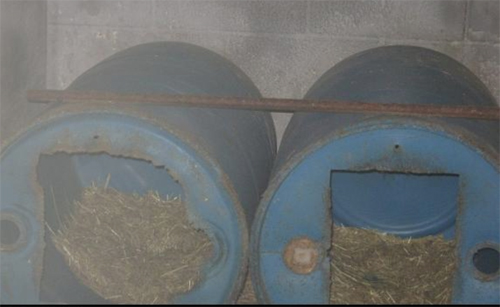
Photo from Schroeder breeding facility; USDA license revoked in 2014.
RESPONSIBLE BREEDING Responsible dog and cat breeding facilities do not tolerate animal suffering. Their policies include meeting the person or family who will care for the animal, and placing each animal with a spay and neuter contract. They understand the enormous amount of time and money it takes to properly care for each animal. If you are a breeder who has seen the harm inflicted by negligent breeders on animals, speak up. If you are a consumer, never buy from a breeder that does not meet the highest standards for the care of treatment of the adult animals or litters. Read more about breeder ethics:
|
 |
"));